
.png)

Back
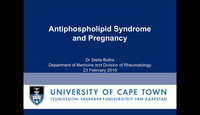
Antiphospholipid syndrome in pregnancy
Dr. Stella Botha | Clinical
Information on the clinical features and associated feature of APS syndrome as well as treatment.
Dr Botha discusses the current classification for
| Topic / Title of the Talk | Antiphospholipid syndrome in pregnancy |
| Field of Medicine | Internal Medicine |
| Length of the Talk | 22 Mins |
| CPD Accreditation No. | MDB015/MPDP/070/34 |
| Category of the Talk | Subject review or overview |
| CPD Type | Clinical |
| Languages (Translations) & Subtitles | Not Translated |
| Speaker | Dr. Stella Botha |
Talk Description
Dr Botha poses the question of how to treat two case studies which she presents. One of a 30 year old female with livedo reticularis in both legs who has had severe pre-eclampsia and a still birth at 34 weeks and who may want to become pregnant again. The second case is of a 34 year old who has had a pregnancy and is now 24 weeks pregnancy and whose symptoms include arthralgia, fatigue and left side weakness.
Botha provides information on APS syndrome and describes the major clinical features and associated clinical features, such as leg ulcers, transverse myelitis, headaches, etc. As a result of the diverse range of clinical features, this conditions gets seen by a number of specialist disciplines and thus she stresses the importance of recognising the condition and provides information on treatment.
Dr Botha discusses the current classification for definite APS and adds that the clinical classification has not been revised for some time and that there is a working group currently in the process of revising the classification, which will be published soon.
She discusses pregnancy outcomes and risk factors.
She also discusses the pathogenesis of pregnancy morbidity in APS and looks at the risk for thromboembolic disease in pregnancy – with venous thromboses more common than arterial thrombosis.
Botha briefly explores neonatal APS.
This presentation also discusses recommendations for prevention of recurrent of thrombosis in APS; the treatment of APS in pregnancy; what to do when asprin/heparin treatment fails; and, the management of pregnancy in aPL and women, including athrombotic therapy;
The presentation concludes with information on a study which looked at 1000 women with APS.
Botha provides information on APS syndrome and describes the major clinical features and associated clinical features, such as leg ulcers, transverse myelitis, headaches, etc. As a result of the diverse range of clinical features, this conditions gets seen by a number of specialist disciplines and thus she stresses the importance of recognising the condition and provides information on treatment.
Dr Botha discusses the current classification for definite APS and adds that the clinical classification has not been revised for some time and that there is a working group currently in the process of revising the classification, which will be published soon.
She discusses pregnancy outcomes and risk factors.
She also discusses the pathogenesis of pregnancy morbidity in APS and looks at the risk for thromboembolic disease in pregnancy – with venous thromboses more common than arterial thrombosis.
Botha briefly explores neonatal APS.
This presentation also discusses recommendations for prevention of recurrent of thrombosis in APS; the treatment of APS in pregnancy; what to do when asprin/heparin treatment fails; and, the management of pregnancy in aPL and women, including athrombotic therapy;
The presentation concludes with information on a study which looked at 1000 women with APS.
Related Talkz
 new.png)
