.jpg)

Back
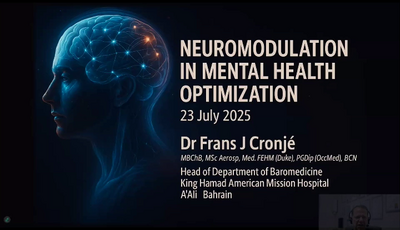
Neuromodulation in Mental Health Optimization
Dr. Frans Cronje | Clinical
This video explores four neuromodulation therapies—HBOT, NFB, tDCS, and KB220—to optimize brain health and resilience in high-risk professionals.
| Topic / Title of the Talk | Neuromodulation in Mental Health Optimization |
| Field of Medicine | Neurology |
| Length of the Talk | 55 Mins |
| CPD Accreditation No. | MDB015/MPDP/070/1541 |
| Category of the Talk | Subject review or overview |
| CPD Type | Clinical |
| Languages (Translations) & Subtitles | Not Translated |
| Speaker | Dr. Frans Cronje |
Talk Description
Mental health challenges such as trauma-related symptoms, cognitive fatigue, and emotional dysregulation are increasingly common in both clinical and high-performance environments. This presentation outlines a non-pharmacological model that optimizes brain health using four complementary neuromodulation modalities. Hyperbaric Oxygen Therapy (HBOT) enhances cerebral oxygenation, supports neurogenesis, and reduces inflammation in conditions like mild traumatic brain injury, long COVID, and PTSD. Neurofeedback (NFB) uses EEG-based feedback to train self-regulation and normalize dysregulated brainwave patterns, improving emotional resilience, focus, and cognitive flexibility. Transcranial Direct Current Stimulation (tDCS) modulates cortical excitability via low-intensity stimulation of the dorsolateral prefrontal cortex, enhancing mood regulation, attention, and executive function. KB220, a pro-dopamine neuroadaptogen, stabilizes reward circuitry and supports neurotransmitter balance, facilitating better engagement with NFB and tDCS. Clinical case studies and evidence-based protocols (Oxford CEBM Levels 1b–3) demonstrate measurable improvements in cognition, mood, and performance across all four modalities, individually and in combination. The integrative approach is particularly suited to individuals in safety-critical roles, such as aviation, diving, and emergency response, where pharmacologic treatments may be limited or stigmatized. By reframing “mental health” as “brain health,” this model reduces stigma and promotes functional recovery. It aligns with both patient preference and regulatory priorities, offering a holistic solution for brain health. These neuromodulation strategies represent a scalable, evidence-supported framework for resilience in clinical and occupational settings. The approach provides practical solutions for maintaining optimal mental fitness and excelling in demanding roles.
Related Talkz



.jpg)