


Back
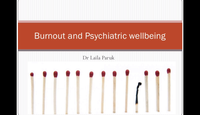
Burnout & psychiatric wellbeing
Dr. Laila Paruk | Ethics
“Burnout” seems to have become a mass phenomenon, receiving constant media attention. More and more people are missing work and school due to burn
| Topic / Title of the Talk | Burnout & psychiatric wellbeing |
| Field of Medicine | Psychiatry |
| Length of the Talk | 17 Mins |
| CPD Accreditation No. | MDB015/MPDP/070/56 |
| Category of the Talk | Overview |
| CPD Type | Ethics |
| Languages (Translations) & Subtitles | Not Translated |
| Speaker | Dr. Laila Paruk |
Talk Description
“Burnout” seems to have become a mass phenomenon, receiving constant media attention. More and more people are missing work and school due to burnout. But is this set of symptoms a clearly-defined illness? How is burnout different from depression and anxiety? Wellness is an active process of becoming aware of and making choices toward a healthy and fulfilling life. Wellness is more than being free from illness, it is a dynamic process of change and growth.
"...a state of complete physical, mental, and social well-being, and not merely the absence of disease or infirmity." The World Health Organization
"a conscious, self-directed and evolving process of achieving full potential." The National Wellness Institute
The term “burnout” was coined in the 1970s by the American psychologist Herbert Freudenberger. He used it to describe the consequences of severe stress and high ideals in “helping” professions. Doctors and nurses, for example, who sacrifice themselves for others, would often end up being “burned out” – exhausted, listless, and unable to cope. Nowadays, the term is not only used for these helping professions, or for the dark side of self-sacrifice. It seems it can affect anyone, from stressed out careerists and celebrities to overworked employees and homemakers.
A stressful lifestyle can put people under extreme pressure, to the point that they feel exhausted, empty, burned out, and unable to cope. Stress at work can also cause physical and mental symptoms. Possible causes include feeling either permanently overworked or under-challenged, being under time pressure, or having conflicts with colleagues. Exhaustion is a normal reaction to stress, and not a sign of disease. So, does burnout describe a set of symptoms that is more than a "normal" reaction to stress? And how is it different from other mental health problems?
Maintaining an optimal level of wellness is crucial to live a higher quality life. Wellness matters. Wellness matters because everything we do and every emotion we feel relates to our wellbeing. In turn, our well-being directly affects our actions and emotions. It's an ongoing circle. Therefore, it is important for everyone to achieve optimal wellness to subdue stress, reduce the risk of illness and ensure positive interactions.
"...a state of complete physical, mental, and social well-being, and not merely the absence of disease or infirmity." The World Health Organization
"a conscious, self-directed and evolving process of achieving full potential." The National Wellness Institute
The term “burnout” was coined in the 1970s by the American psychologist Herbert Freudenberger. He used it to describe the consequences of severe stress and high ideals in “helping” professions. Doctors and nurses, for example, who sacrifice themselves for others, would often end up being “burned out” – exhausted, listless, and unable to cope. Nowadays, the term is not only used for these helping professions, or for the dark side of self-sacrifice. It seems it can affect anyone, from stressed out careerists and celebrities to overworked employees and homemakers.
A stressful lifestyle can put people under extreme pressure, to the point that they feel exhausted, empty, burned out, and unable to cope. Stress at work can also cause physical and mental symptoms. Possible causes include feeling either permanently overworked or under-challenged, being under time pressure, or having conflicts with colleagues. Exhaustion is a normal reaction to stress, and not a sign of disease. So, does burnout describe a set of symptoms that is more than a "normal" reaction to stress? And how is it different from other mental health problems?
Maintaining an optimal level of wellness is crucial to live a higher quality life. Wellness matters. Wellness matters because everything we do and every emotion we feel relates to our wellbeing. In turn, our well-being directly affects our actions and emotions. It's an ongoing circle. Therefore, it is important for everyone to achieve optimal wellness to subdue stress, reduce the risk of illness and ensure positive interactions.
Related Talkz




 new.png)